Van Cortlandt House: The Bronx’s Oldest House and the Labor Behind It
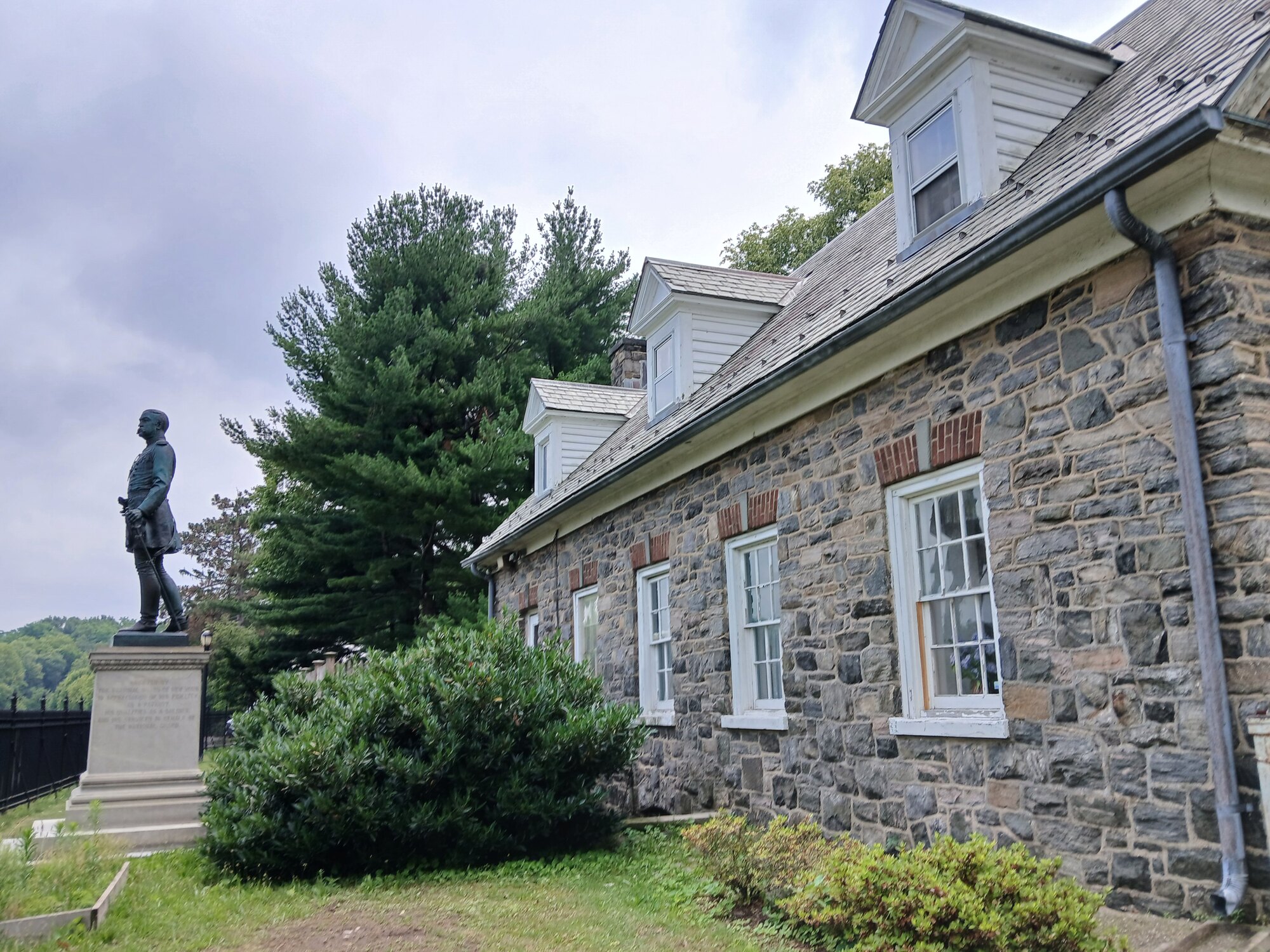
Van Cortlandt House, June 2026. Photograph by Epicgenius, via Wikimedia Commons. CC BY-SA 4.0.
Van Cortlandt House stands near Broadway in a quiet corner of Van Cortlandt Park, but it was not built as a retreat from the city. When Frederick Van Cortlandt commissioned the house in 1748, this was a working plantation in what was then Yonkers, Westchester County. The house survives as the Bronx’s oldest dwelling and one of New York’s finest Georgian manor houses. Its history also reaches beyond the prominent family named on the façade to the enslaved people whose work sustained the property.
Frederick’s father, Jacobus Van Cortlandt, was a wealthy merchant and former mayor of New York. He began assembling land in the area during the 1690s. The family eventually controlled an estate extending far beyond today’s park. In 1701, Jacobus paid Munsee Lenape people in an effort to secure legal ownership of land that the family called its “Yonkers plantation.” Fields of wheat, rye, corn, and buckwheat surrounded livestock, mills, roads, and the dammed waters of Tibbetts Brook.
The two-and-a-half-story house was built in 1748-49 from local fieldstone with red-brick trim. Its architect and builders are unknown. The exterior is restrained but not plain: carved masks form unusual keystones over the windows, and dormers punctuate the sloping roof. The New York City Landmarks Preservation Commission praised the building’s vigorous Georgian design, masonry, wood windows, and cornice when it designated the exterior in 1966.
Frederick Van Cortlandt died before the work was fully complete. More importantly, the surviving records do not allow the house to be understood as the achievement of one owner alone. Three generations of Van Cortlandts held enslaved Africans on the property from 1698 until 1823. The Van Cortlandt Park Alliance notes that enslaved people almost certainly participated in construction. They later carried water and waste, prepared food, cleaned rooms, cut wood, maintained fires, cared for family members, farmed the land, worked the mills, built roads, and helped dam Tibbetts Brook.
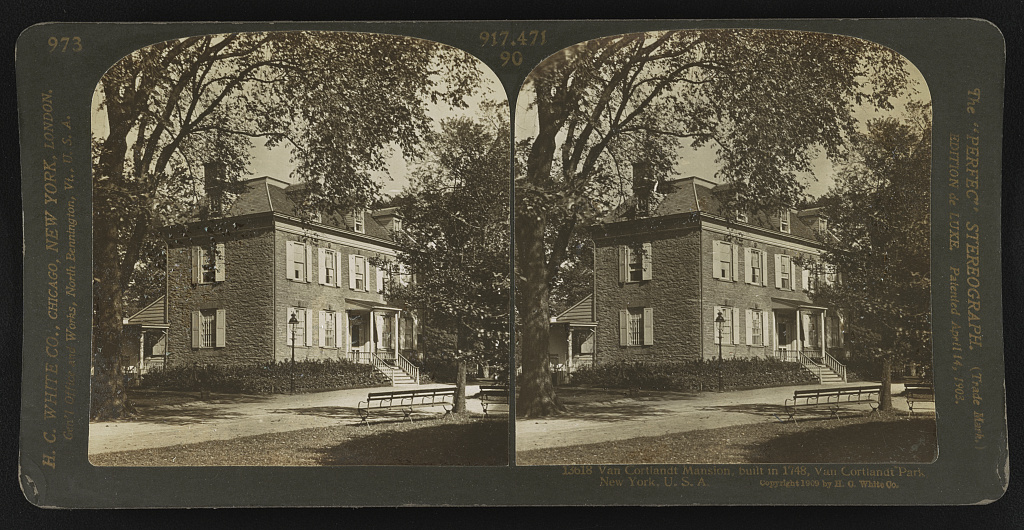
Van Cortlandt Mansion, 1898. H. C. White Co., Library of Congress. No known restrictions on publication.
Some names survive. Piero worked as a miller, Levellie as a boatman, and Dinah cared for Augustus Van Cortlandt’s wife during her final illness before receiving her freedom in 1821. An architectural investigation found that enslaved servants slept in an unheated attic room. The museum’s current interpretation brings those lives into a story that earlier generations often told mainly through owners, officers, and furnishings.
The Revolutionary War placed the house on contested ground. British and Patriot forces alternately controlled the surrounding area. George Washington stayed here in 1776 and returned in 1781 and 1783. According to a long-repeated story, campfires near the family burial vault misled British forces while American troops moved toward Yorktown. Augustus Van Cortlandt, New York City’s clerk, also hid municipal records in the family vault to protect them during the war.
The landscape changed radically in the late nineteenth century. New York City acquired the estate for parkland in the 1880s, and the family’s former agricultural property became part of a major public park. The National Society of Colonial Dames in the State of New York opened the house as a museum in 1897 and has operated it under a city license ever since. The house was restored and furnished to suggest the period from 1749 to 1823, though the museum explains that only a small portion of its period collection belonged to the Van Cortlandts.
Today the house belongs to the city and remains a public museum within NYC Parks’ Historic House Trust. Its exterior and significant interiors are New York City landmarks, and it is both listed on the National Register of Historic Places and designated a National Historic Landmark. The Colonial Dames’ operating agreement with the city was renewed in 2024.
Van Cortlandt House preserves exceptional eighteenth-century architecture, but its strongest value is the way the site can hold several histories at once. It is a Georgian manor, a Revolutionary War landmark, a city museum, and evidence of a plantation economy built through coerced labor. Seeing all of those layers makes the old stone house more, not less, important to the Bronx.